

London, UK – UK Home Secretary Shabana Mahmood announced on November 20 a series of reforms to the UK’s legal migration model on behalf of the Labour government, stating that settlement is a privilege to be “earned” by migrants.
Under the proposed changes, the minimum period of residence required to qualify for permanent settlement- known as Indefinite Leave to Remain (ILR)- would be increased from five to ten years for many, as part of the government’s effort to stabilise the pace and scale of migration in the UK.
ILR allows individuals to live and work in the UK indefinitely, as well as access public funds- including benefits and tax credits- on the same basis as British citizens. The UK saw 173,000 grants of settlement from March 2024 to March 2025, representing a 33% increase from the previous year, according to the Home Office Accredited Official Statistics.
To qualify for settlement, migrants will need to meet a series of criteria: a clean criminal record; an A-Level standard of English; sustained National Insurance contributions; and no outstanding debt in the UK.
Mahmood outlined a series of tests that have been published for consultation, which could either extend or reduce the 10-year qualifying period for ILR, depending on the “particular value to society” that migrants may bring to the UK.
Migrants who speak English to degree-level standard could qualify for a nine-year path to settlement; those who work in public service or pay higher tax rates, a five-year path; and those on the top tax rate, or Global Talent visas, would be granted a three-year path.
By contrast, settlement could take up to thirty years for migrants who arrive illegally, and fifteen years for those who receive benefits for less than twelve months during their time in the UK.
While Mahmood assured that immigration rules would not change for those who already hold settled status, the impact of such proposals on those migrants currently going through the process remains uncertain.
“We propose these changes apply to everyone in the country today, who has not yet received Indefinite Leave to Remain,” Mahmood said.
However, she noted that the government is seeking input on whether “transitional arrangements” should also be introduced- suggesting the potential creation of different provisions for migrants already on the path to settlement.
Experts weigh in
The Home Affairs Committee, a cross-party committee of MPs responsible for examining government policy, launched an inquiry in October into the Labour Government’s proposed reforms to the eligibility criteria for ILR.
First introduced in the May Immigration White Paper, the plans have since been further detailed by the Home Secretary.
“Changing the rules governing who has the right to Indefinite Leave to Remain is likely to have a complex and wide-ranging impact. We have launched this inquiry to understand how well the government’s proposals will help them achieve their goals for immigration and their broader policy aims,” said Conservative MP Dame Karen Bradley, who launched the inquiry.
The review was open for written submissions until December 2, and seeks evidence on the impact of the government’s proposals on settlement rates, migration flows, businesses and employers, and integration.
It will also examine the personal, social and financial impacts on migrant households, including access to benefits.
While speaking with EU Reports, Dr. Ilona Pinter, researcher at the Centre for Analysis of Social Exclusion (CASE) at the London School of Economics and Political Science (LSE), highlighted the “huge financial pressures” faced by migrants- including thousands of pounds in Home Office fees and the Immigration Health surcharge
Immigration has risen significantly since the COVID 19 pandemic, driven by the establishment of the Health and Social Care Visa and by increased arrivals of people fleeing war and human rights abuses in Ukraine, Hong Kong, and Afghanistan, among others.
Dr. Pinter noted that extending routes to settlement could have serious consequences for children, saying that families with no recourse to public funds (NRPF) cannot access child-specific benefits such as Child Benefit, Scottish Child Payment, Disability Living Allowance, Child Disability Payment, or most childcare support.
Migrant households in these situations are particularly vulnerable during periods of hardship, including redundancy, illness, or bereavement. Changes to the eligibility criteria for ILR could therefore affect the development and well-being of children in migrant households.
“Children with foreign-born parents are already more likely to face poverty, including deep poverty, than their peers — part of this is because of ‘no recourse to public funds’ restrictions,” said Dr Pinter.
“Extending the routes to settlement for more children will mean that more are prevented from accessing this vital support and will remain in poverty,” she added.
Although Home Secretary Mahmood spoke on the possibility of transitional pathways being available for migrants, the proposed extension period for ILR implies that families will have to pay twice as much to receive settled status.
The Institute for Public Policy Research (IPPR) estimated in June that 1.7 million individuals already living in the UK, including children, could be affected by the government’s proposals.
This estimate, however, does not account for Mahmood’s recent announcement, which appears to extend the proposals beyond the work route to settlement to include the family and private life ten-year settlement routes. The revised proposals suggest that a larger number of individuals, including children, could be impacted.
Immigration debate continues
Debate around immigration remains prominent in the UK, marked by a wave of both anti-immigration and pro-immigration demonstrations this year, along with a noticeable rise in the display of St. George’s and Union Jack flags across the country.
In February, the Conservative Party proposed the same extension to ILR eligibility as the Labour Government, increasing the qualifying period from five to ten years. Kemi Badenoch, leader of the Conservative Party, criticised the Labour Government’s approach:
“UK citizenship should be a privilege that is earned through commitment and contribution to our country. I have always said that the UK is not a dormitory or a hotel: it is our home.”
The rightist Reform UK party announced its plans in September to abolish ILR entirely and adopt a system of five-year renewable work visas, similar to those used in the United States and the United Arab Emirates.
Reform UK continues to lead YouGov voting intention polls, holding 26% of voter popularity in November 2025.
The party’s rising popularity has caused concern among legal immigrants in the UK, especially those who already hold ILRs and fear the uncertainty that any move to revoke their status could create.
“Maja”, a Polish national who has lived in the UK for seven years and holds ILR- and wishes to remain anonymous for security concerns- spoke to EU Reports about the emotional impact the debate has had on her and her family:
“There were days when I was so stressed that I had to stop watching the news. I feel quite powerless when it comes to politics in the UK as an individual,” she stressed.
Immigration solicitor Alison Hunter also told EU Reports that attempts to withdraw ILR from existing holders would likely face legal challenges centred on “legitimate expectation” and human rights, including the right to private and family life.
Hunter also warned that the cost and uncertainty of legal proceedings could deter migrants from bringing arguments to court, and potentially “have a chilling effect” on the number of mobile migrants coming to and settling in the UK — workers whose skills are needed worldwide.
Unlike other blocs, Green Party leader Zack Polanski argues that the UK faces issues related to inequality rather than migration:
“We’ll say it loud, we’ll say it clear: migrants and refugees are welcome here,” said Polanski at his first conference speech as leader in October.
The Labour Government’s “Earned Settlement” model will be subject to government consultation until February 12, 2026, with new immigration rules expected to take effect from April 2026.
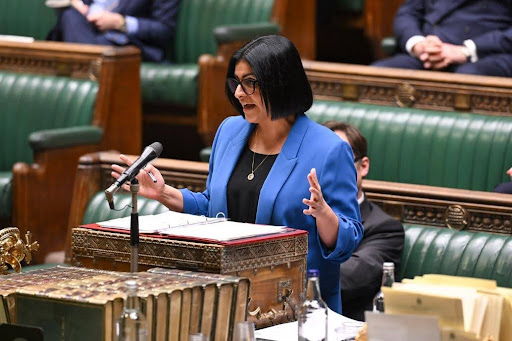
Featured Image: Shabana Mahmood in the House of Commons
Credit: House of Commons via Flickr
License: Creative Commons Licenses