

Madrid, Spain – Spanish Prime Minister Pedro Sánchez will explain his government’s stance against the war in Iran, which has rallied anti-U.S. sentiment beyond the country’s borders.
Sánchez has asked to address the Spanish parliament on March 25, after crucial regional elections in the Castilla y Leon autonomous community, which may prove a pointer for general elections in Spain next year.
The prime minister’s anti-war stance has garnered support within Spain but has prompted splits within the European Union.
German chanceller Friedrich Merz said on March 3 during a meeting with U.S. President Donald Trump that Germany was trying to persuade Spain to increase defence spending – a remark which other EU nations said showed lack of support for Sánchez.
Last week, in a televised address, Sánchez warned that the conflict risked triggering a major global disaster.
“We’re not going to be complicit in something that’s bad for the world, nor contrary to our values and interests, simply to avoid reprisals from someone,” he told Spaniards.
“This is how humanity’s great disasters start … You cannot play Russian roulette with the destiny of millions,” he said, highlighting the negative knock-on effects of the Iraq war — from a rise in jihadist terrorism to soaring energy prices — to argue that the consequences of the attack on Iran were just as nebulous.
Aleksandra Sojka, an expert in EU-Spanish foreign policy at Carlos III University in Madrid, told EU Reports that Sánchez had “capitalized” on anti-Trump feeling within the EU:
“I think that Sánchez has capitalized on the disagreement within Europe with the U.S. war and he has expressed this out loud. In this sense he has played a very intelligent role as there is a lot of anti-Trump feeling but some countries do not want to ruffle feathers any more with the U.S. by expressing it out load,” she said.
Dr. Sojka said Sánchez took this stance because he is aware many Spaniards oppose current U.S. foreign policy.
A snap poll in El País, a left-leaning Spanish daily, published on March 6 found that 68% — more than two thirds – opposed the U.S.-Israeli war against Iran, while 23.2% supported it. Pollsters surveyed 500 people.
The international media seized on the fact Sánchez was the only European leader to defy President Trump openly – despite an American threat to cut trade.
In an editorial in The Economist magazine published on March 6, Sánchez said: “Our position stems from the fact that this war is illegal, a major threat to the rules-based international order and contrary to the interests of humanity.”
Unable to pass a budget because of the fractured nature of the Spanish parliament, Sánchez has sought to use foreign policy issues like recognizing the Palestinian state in 2024 and now opposing the U.S.-Israeli attack on Iran to win support.
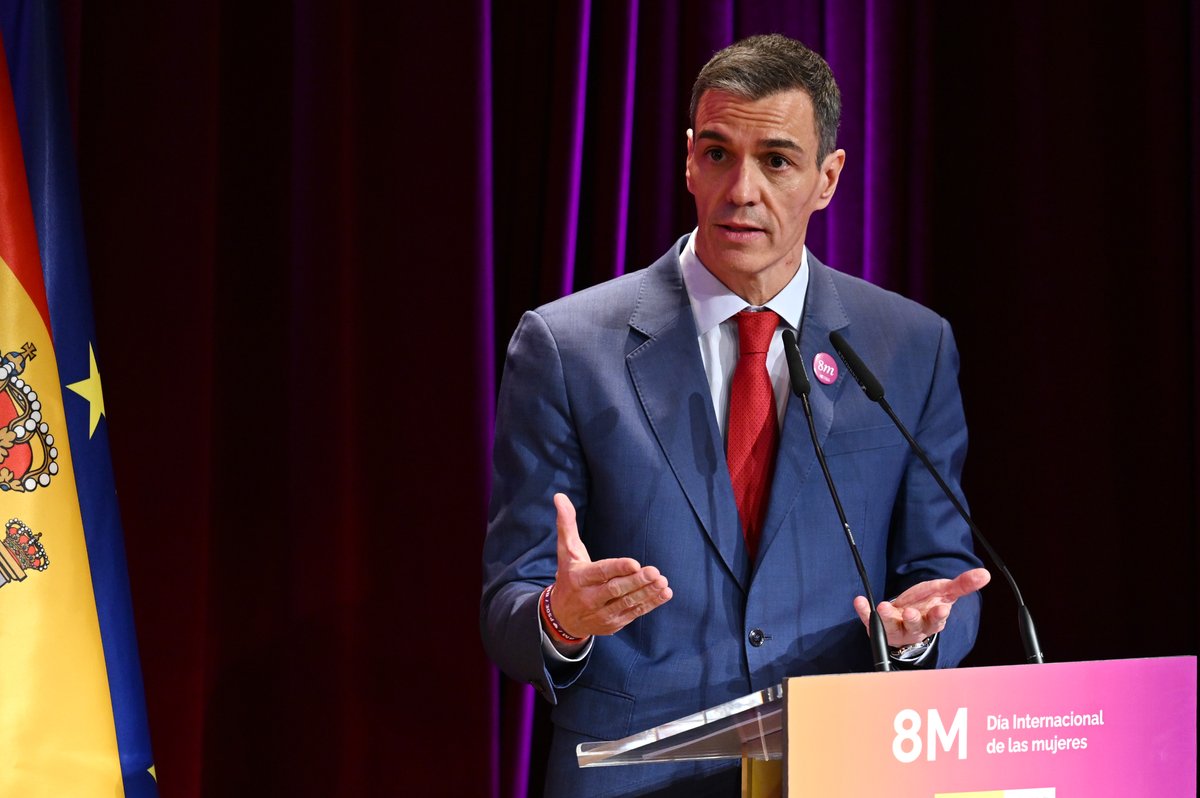
Featured image: La Moncloa via X.