
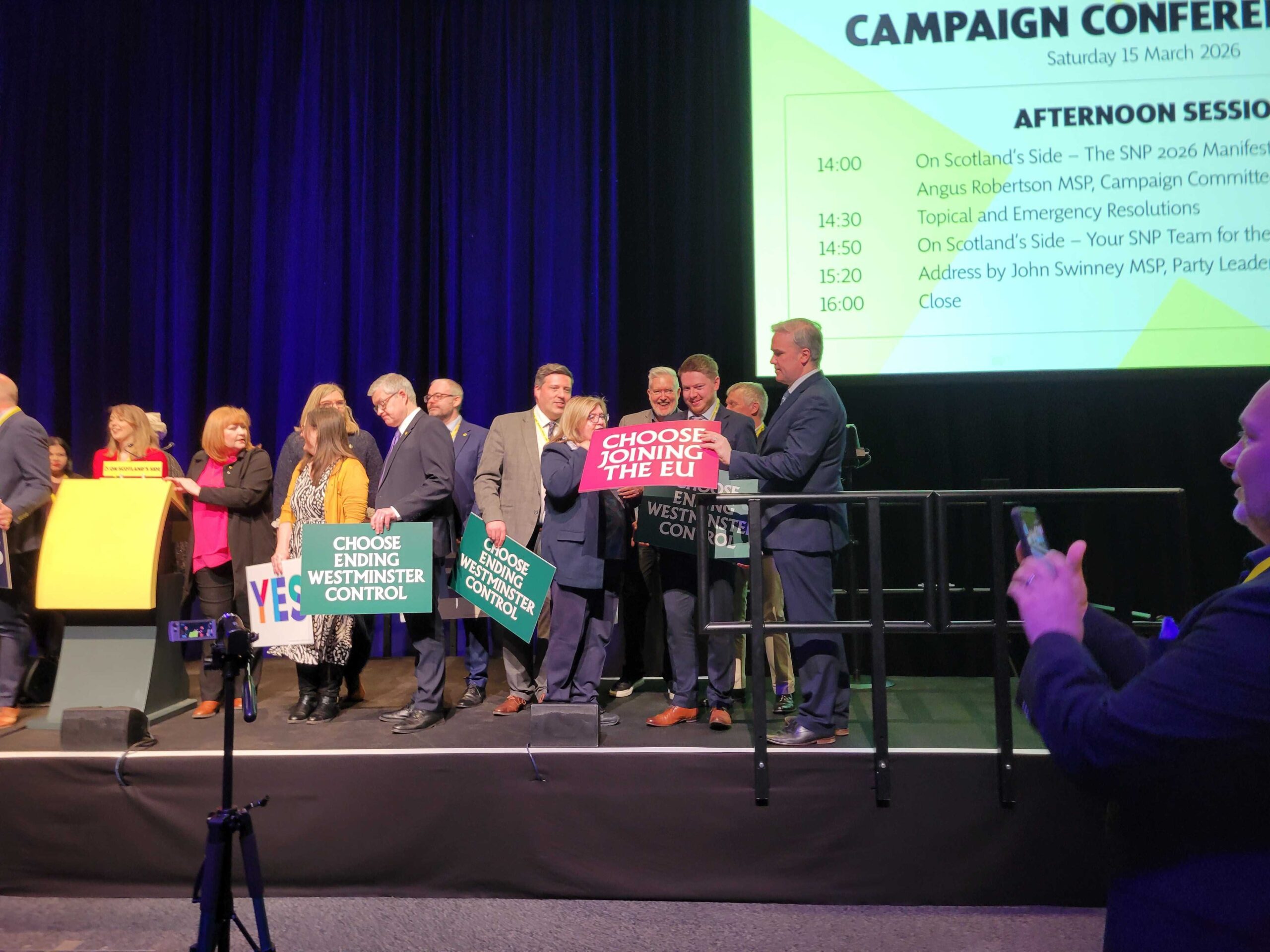
Edinburgh, Scotland – “This election, we are not just in it to win government, we are in it to win independence for Scotland,” said Scottish First Minister John Swinney to a room full of supporters at the Scottish National Party (SNP)’s conference on March 14.
With less than two months to go before the country’s elections on May 7, the ruling SNP made one thing clear throughout their conference: this election is going to be a litmus test on whether Scots are ready for independence.
Swinney has promised that if the SNP win a majority in May, they will launch an independence referendum for the first time since 2014. If the referendum is successful, Scotland could, as Swinney put it, “take our place as Europe’s newest member state.”
Recent polling shows the SNP winning just shy of the majority they would need to put forward the referendum.
At the party conference however, morale is high, and delegates are more than ready to discuss what an independent Scotland would look like. In fact, they’re urging the UK government to do the same.
Preparing for independence
Glasgow councillor Norman MacLeod presented the “Preparing for independence” resolution, which passed unanimously. It called upon the UK government to begin “preparations for the time to come when it may no longer be able to rely upon continuing subsidies from Scotland.”
MacLeod and Edinburgh-based activist Alex Orr, both of whom supported the resolution, argued that the rest of the UK needed to start thinking about how the economy would change without Scotland’s resources, particularly energy resources, at their disposal.
“Careful preparation can make any future relationship stronger and more constructive,” said Orr. “This allows institutions to plan sensibly, reduce uncertainty for businesses and communities, and avoid rushed decisions when independence becomes a reality.”
Gareth Morgan, another delegate, proposed expanding the resolution to recommend that the UK prepare not only for an independent Scotland, but an independent EU member on its northern border. Although this proposal was rejected, the October 2025 conference already established that an independent Scotland would seek EU membership.
Speaking to EU Reports, MacLeod made it clear that his vision for an independent Scotland involves EU membership:
“We were made very, very welcome within the European Union,” he said. “We look forward to renewing that as soon as [possible], because it might take a minute or two to get back into full EU membership.”
For the councillor, the biggest advantages of EU membership would be freedom to travel across the EU and the ability to export Scottish goods without tariffs.
Current attitudes towards independence
The SNP have been in power in Scotland since 2007, and won a majority government in 2011, which led to the independence referendum of 2014. The pro-independence side lost after receiving only 45% of the vote. However, widespread opposition to Brexit and a new generation of young voters may yield a different outcome.
EU Reports spoke to Ryan Stewart, a delegate from Young Scots for Independence, who was eight years old in the 2016 Brexit referendum. He believes that being an EU member once more would unlock many doors for young people in Scotland.
“Obviously Scotland voted in a supermajority to remain in the EU, so it feels inherently undemocratic that because of England and Wales’ opinion, we get dragged out as well,” he said.
He also noted that it’s important for Scotland to stand with the EU against geopolitical threats to democracy coming from Russia, China, and the United States.
Although the SNP and their supporters view the upcoming elections as a mandate for independence, data shows that independence is not necessarily among voters’ highest priorities. A Savanta poll commissioned by the BBC found that voters were most concerned with cost of living and healthcare by far, followed by the economy, immigration, and housing.
The SNP Conference addressed many of these issues, such as by promising to open 30 new walk-in general practitioner clinics across the country, and passing resolutions to invest public pension funds in social housing, champion land reform in government, and renew the New Scots Refugee Integration Strategy.
Featured image: Courtesy of Emma Bainbridge