
The rules-based international order is no longer sufficient to protect the European Union from the current “precarious” global situation, according to European Commission President Ursula von der Leyen.
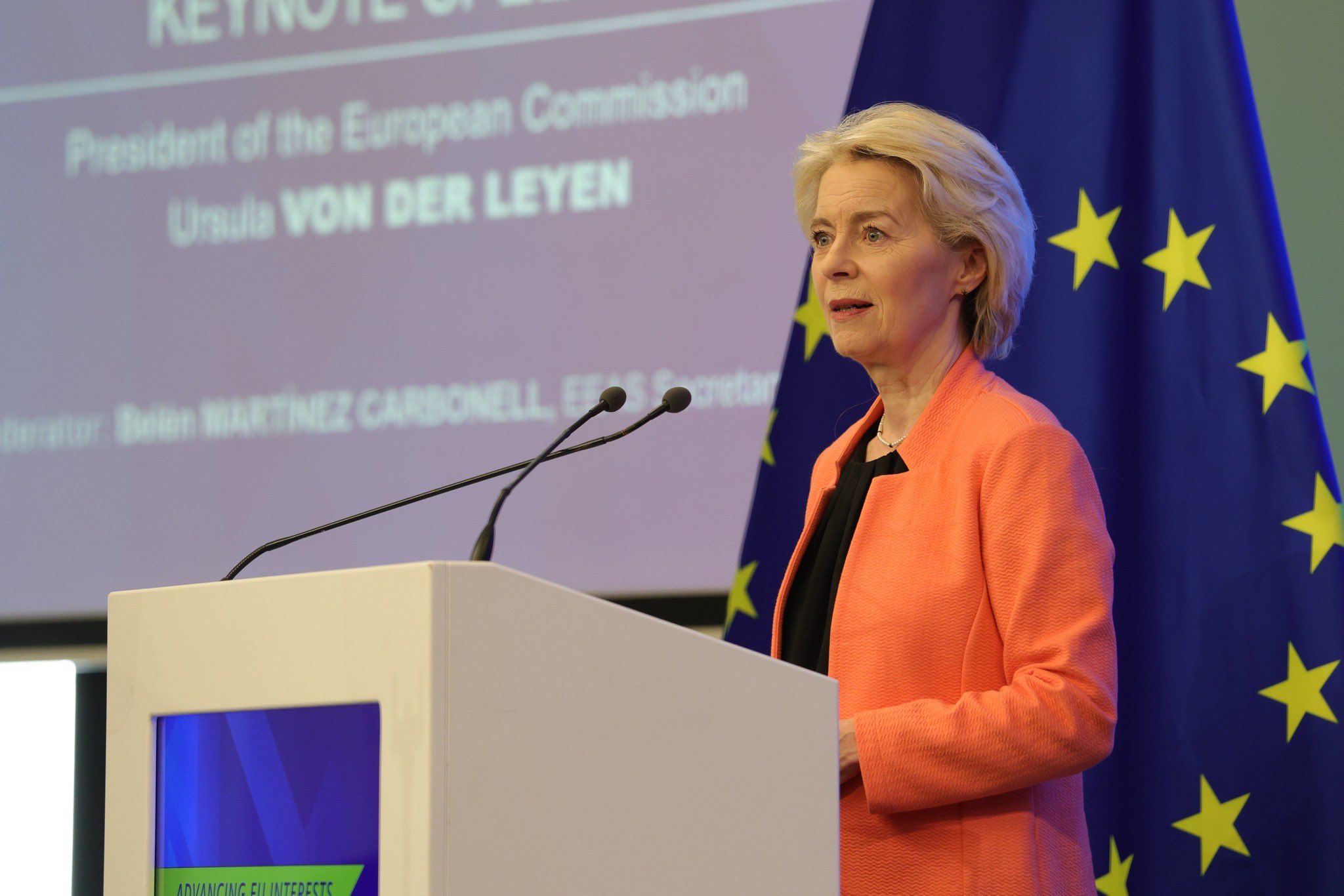
Speaking at the EU Ambassadors Conference on Monday, March 9 in Brussels, the leader cautioned that Europe would have to become “more resilient, more sovereign and more powerful,” to retain its independence.
Amidst the ongoing U.S.-Israel war on Iran, she warned that “Europe can no longer be a custodian for the old-world order, for a world that has gone and will not return.”
“We urgently need to reflect on whether our doctrine, our institutions and our decision making – all designed in a postwar world of stability and multilateralism – have kept pace with the speed of change around us.”
“Whether the system that we built – with all of its well-intentioned attempts at consensus and compromise – is more a help or a hindrance to our credibility as a geopolitical actor,” she added.
The former German defence minister – and first woman ever to occupy such a position – has faced criticism for her handling of the war. Speaking to POLITICO, European officials accused the President of overstepping her diplomatic reach in the early days of the conflict.
Von der Leyen went further than EU Foreign Affairs head Kaja Kallas in calling for regime change in Iran and speaking with multiple state leaders following the outbreak of conflict.
However, she avoided pronouncing judgements on the U.S-Israel strikes on Iran in her speech, instead affirming that the EU had to face the “reality of the situation” and accept that the union “cannot solve every global issue.” This approach differs from the condemnations heard from Spain’s Pedro Sánchez and France’s Emmanuel Macron.
Von der Leyen also underlined the necessity for “more connections with reliable, trusted partners” to strengthen both trade and security relationships.
This year has seen the EU make historic free trade deals with India, representing 25% of global GDP, and with the South American Mercosur bloc, composed of Argentina, Brazil, Uruguay, and Paraguay.
In a following speech, Kallas underlined the importance of global partnerships, highlighting nine existing security and defence agreements as well as future deals with Australia, Iceland, and Ghana.
Von der Leyen’s remarks came after her discussion alongside European Council President António Costa with leaders of thirteen Middle Eastern nations including Jordan, Lebanon, the United Arab Emirates, and Saudi Arabia.
A joint press statement said that the EU counterparts “condemned the indiscriminate attacks by Iran in the strongest terms and conveyed their full solidarity with the people of the region”.
Featured image: Ursula von der Leyen via X.