
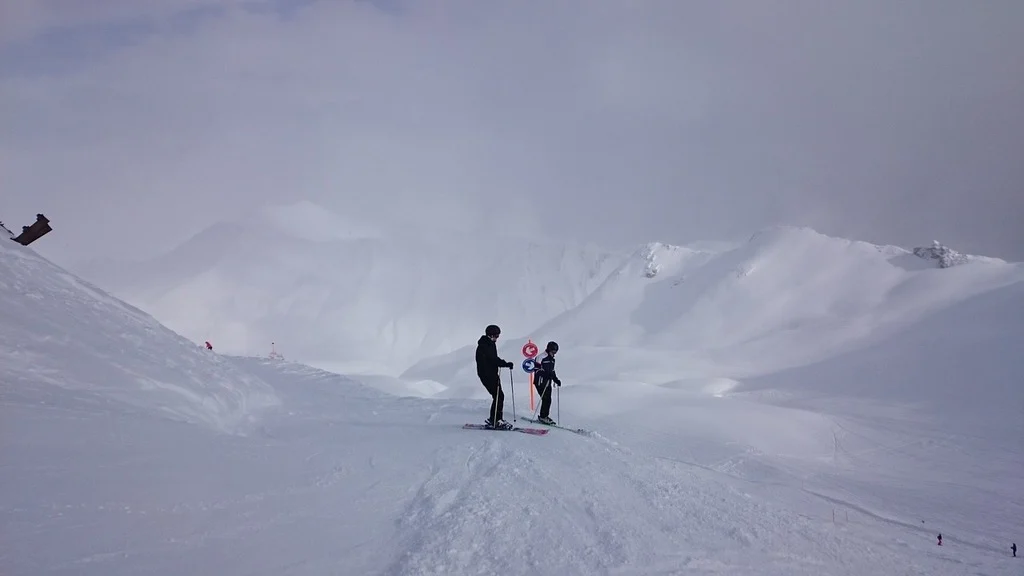
Verbier, Switzerland – The European Avalanche Warning Services reported that 125 people have died in avalanches across Europe this winter. Of these casualties, 106 fatalities – or 85% – were recorded in the Alpine countries of Austria, France, Italy, and Switzerland.
Most victims this season were caught in off-piste terrain, having ventured beyond marked runs despite avalanche warnings. A report published last year by the Swiss Council for Accident Prevention found that 85% of fatal winter sports accidents happen off-piste.
Avalanches occur when snow accumulates on slopes steeper than 30 degrees and is set off by a trigger – such as fresh or melting snowfall, a person, an animal, or wind. While these elements are present every winter, the specific metrological conditions in the Alps this year have contributed to this rise in fatalities.
Stéphane Bornet, director of the National Association for the Study of Snow and Avalanches, explained to CNN that early heavy snowfall in November, followed by a dry spell, created weak “angular grains” that do not bond well.
These fragile layers are not dangerous alone, but when covered by fresh snow – as the Alps received in February – they can be easily triggered and “act a bit like ball bearings,” the expert explained.
Although it is difficult to prove that climate change directly leads to avalanches, the phenomenon causes dramatic temperature swings that create these unstable layers in the snowpack.
Many off-piste venturers see only untouched snow, unaware of its composition. As they are seduced by the prospect of fresh powder, despite severe level 4 – and in some areas the highest level 5 – avalanche warnings, they venture across Alpine resorts.
As winters become shorter and more unpredictable, the risk is concentrated into shorter periods, while social media and improved ski technology encourage users to explore terrain they may not fully understand.
Such recklessness devastates victims’ families and avalanche rescue teams who risk their lives in search efforts, and often have to break the news to loved ones when rescues fail.
The rise in Alpine avalanche casualties has prompted calls for better regulation.
Does survival equipment create a false sense of security?
Avalanche safety relies heavily on survival technology like transceivers, which send signals to help locate buried victims, and airbags – backpacks that help keep a person nearer to the snow’s surface. However, research suggests that feeling safer with this equipment may encourage riskier decisions off-piste.
“Airbags are the best and worst thing that have come on to the market over the last decade”, Charlie Tate, an off-piste ski coach of 25 years in the Swiss resort of Verbier, told EU Reports.
Tate said that airbags and transceivers can give people a “false sense of security”, which can lead them into unsafe terrain.
While essential, Tate believes that many off-piste skiers with transceivers do not know how to use them, leaving them helpless when disaster strikes.
In conversation with EU reports, Luca Barletta, Head of Avalanche training Above & Beyond Swiss Brevet Fédéral, similarly stressed that despite advanced Alpine rescue teams, every off-piste goer must understand their equipment.
Avalanche rescues must occur within 10 to 15 minutes of an incident, according to Barletta. And, with today;s heavier snow, “15 minutes is already a lot.”
However, the expert noted that transferring this knowledge, especially to tourists who have a limited time each year to ski, is difficult because “the more time they spend learning the risks the less time they spend skiing.”
Publicity seeking
For many, off-piste skiing is as much about social media fame as the thrill, with countless videos shared online – sometimes even by proud parents filming their children.
A 2025 JMIR Public Health study found that those more invested in online content creation were significantly more likely to report risky behaviours – suggesting a link between pursuit of attention and risk-taking.
Social media platforms are full of content by “freeriders”, high-end off-piste skiers or snowboarders who inspire viewers to emulate their adventures.
Freeride skier known by his signature Big_Mauntain_Bob on Instagram, told EU Reports: “The problem is that viewers see the result, not the assessment behind it. They can normalise risk without normalising competence.”
Bob explained that while he enjoys sharing his videos online, the satisfaction also comes from executing his plan, which includes “studying avalanche patterns, understanding where slabs are likely to propagate, and making my own terrain choices”.
Social media and wider ski designs, which make deeper snow more manageable, have encouraged a wave of powder-hungry and less-experienced skiers to tackle terrain that is entirely new to them. This in itself increases avalanche risk, as inexperience can be deadly – victims are often caught in avalanches triggered above them, even if they didn’t cause it.
“The highest risk group is usually confident intermediates with limited avalanche literacy”, Bob stressed to EU Reports.
“The risk is part of the appeal. But unmanaged risk isn’t,” he continued.
The penalty debate
Mounting calls for better regulation have surged across the Alps. Some in France are pushing for a ban, while Austria considers tougher penalties for those who ignore safety warnings.
In late February, Astrid Mair, security minister of the eastern Austrian state of Tyrol, told Kronen Zeitung that imposing stricter sanctions may be needed to prevent accidents.
“Experience has shown that only high costs, which have to be charged, have a lasting effect,” she told the Austrian newspaper.
Expert ski guides say they hope restrictions similar to those introduced in parts of the U.S. will not be implemented across Europe, arguing they would run counter to Alpine culture, which values the freedom to climb mountains without permits or restrictions.
Barletta further noted that closing lifts to particularly unstable routes until the snowpack settles – as is currently done – is a sensible step, but “regulation is not the way forward”.
Featured image: Via Picryl.
Creative Commons Licenses