
Iceland has set a date for the upcoming referendum on whether the country should move forward on the question of joining the European Union.
The vote will be held on August 29, and will give Icelandic voters the chance to decide if accession talks with the EU should continue.
If voters support continuing negotiations, a further round of talks would follow, after which a second referendum would be held on whether Iceland should join the EU under the terms agreed. If voters reject the proposal, however, the government will end all accession negotiations.
Iceland had initially bid to become a EU member state in 2009, following the global financial crash. However, talks were frozen in 2013 by the centre-right government under Sigmundur Davíð Gunnlaugsson, amid disputes over sectors such as fishing and agriculture, as well as an improving domestic economic situation.
Support for EU membership has grown again in recent years, partly due to renewed security concerns – amplified by comments from U.S. President Donald Trump regarding Greenland and remarks from his nominee for U.S. ambassador suggesting Iceland should become America’s “52nd state.”
Of all NATO member states, Iceland is the only without its own army, making it entirely reliant on support from the U.S. Tariffs on Iceland of 15%, imposed last year, have similarly prompted debate on strengthening ties with the EU.
The current government of Iceland, a centre-left coalition led by Prime Minister Kristrún Mjöll Frostadóttir, was elected on a promise to hold a referendum on whether to pursue EU membership talks by 2027. However, developments in U.S. policy have rapidly accelerated the timetable, raising the possibility that Iceland could join the EU as its 28th member state ahead of other candidates, such as Montenegro.
“The conversation on enlargement is shifting,” stated EU Enlargement Commissioner Marta Kos.
“It is increasingly about security, about belonging and about preserving our ability to act in a world of competing spheres of influence. This concerns all Europeans. A significant decision now lies ahead for the Icelandic people. Accession negotiations always reflect the specific realities of each candidate country.”
This line was echoed by European Commission President Ursula von der Leyen when she met with Frostadóttir in Brussels earlier in the year. She stated that economic cooperation and partnership on the security of the Arctic and the North Atlantic offered “stability and predictability in a volatile world.”
The ALDE Party, a cross-European and multi-party Alliance of Liberals and Democrats for Europe, stated they welcomed this step and Frostadóttir’s leadership of the pro-European voice within Iceland.
“In a world of growing geopolitical challenges, a stronger, united Europe matters more than ever. Iceland belongs in the European family. It is already a member of the European Economic Area and heavily aligned with much of the EU’s current legislation,” ALDE stressed in a press release.
Frostadóttir has emphasized that the coming vote should not be seen in any way as a final decision on this issue, stating that “this is a referendum on whether we can finish the dialogue – not whether we are joining.”
Meanwhile, Icelandic Foreign Minister Þorgerður Katrín Gunnarsdóttir noted: “This referendum is not about the pros and cons of the European Union,” she added. “It’s simply about whether to continue membership negotiations or not. To look at your heart and ask yourself: Do I want to know more? For me, my children and future generations.”
Polls show that Icelanders remain near-evenly split on the issue, with 44-45% in favour of EU membership whilst 30–35% are opposed. Recent polls by Gallup appeared to show this split had narrowed, with around 52% in favour and 48% against, and with many Icelanders appearing to be less in favour of EU membership than they were prior – but more in favour maintaining NATO membership.
Meanwhile, opposition parties have criticized the government’s approach, with a tense debate on the question of a referendum and further talks with the EU having taken place last week in the Althingi, the Icelandic Parliament.
Concerns include that such a referendum is likely only to cause division; Frostadóttir was accused of backtracking on her own statements to this effect made prior to the election.
Currently, polls still show the majority seem favourable towards entering the EU; however this remains neck and neck, with much that could change in the run up to August.
Foreign Minister Gunnarsdóttir also indicated that, if Iceland votes to continue negotiations, they could be completed in as little as a year and a half, as much of the EU’s legislation already applies through Iceland’s membership of the European Economic Area and participation in the Schengen Area.
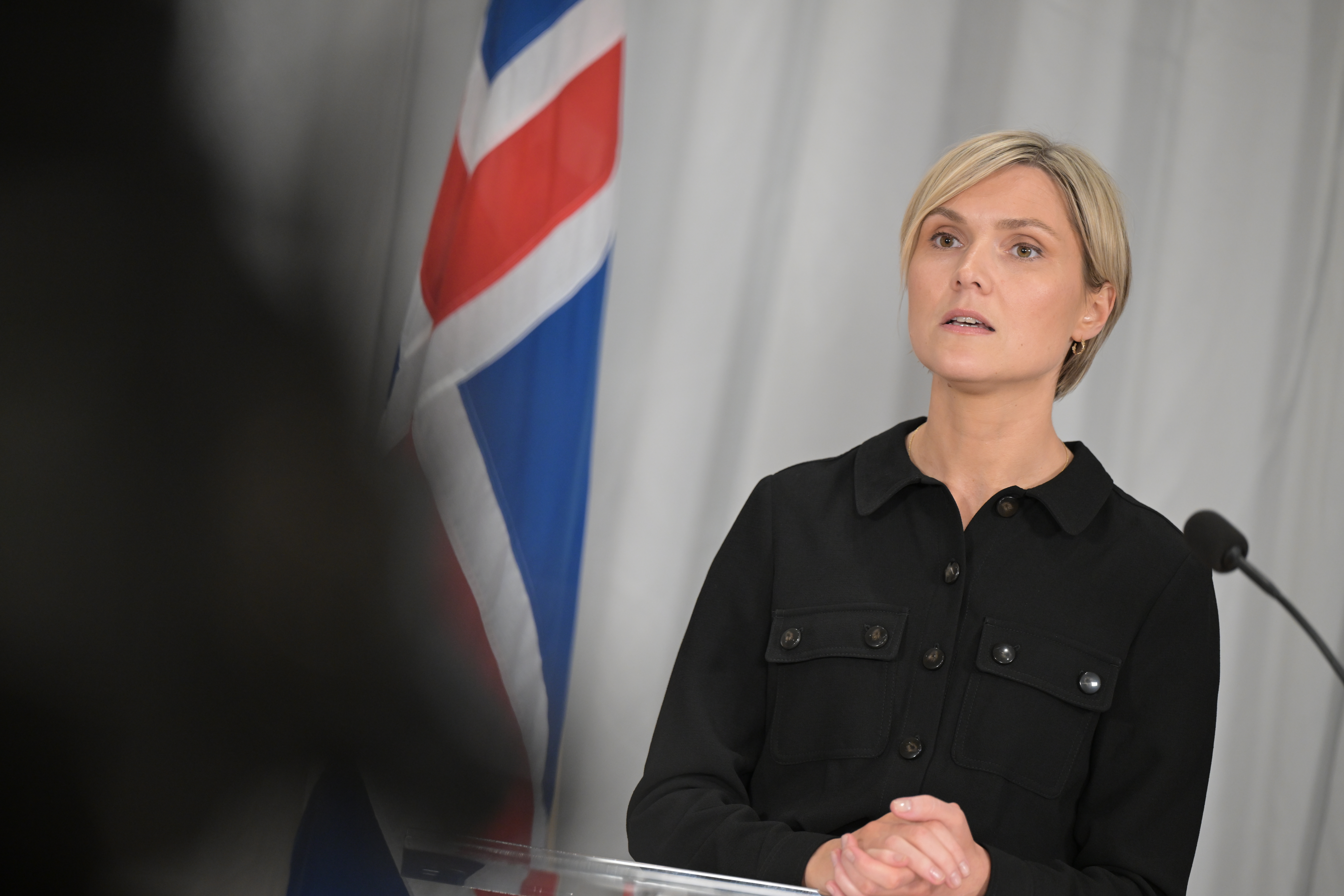
Featured image: Kristrún Frostadóttir, Prime Minister of Iceland, giving a speech during the visit of Ursula von der Leyen, President of the European Commission, to Iceland.
Source: Wikimedia Commons.
Author: Dati Bendo / European Union, 2025 / EC – Audiovisual Service
Creative Commons Licenses