
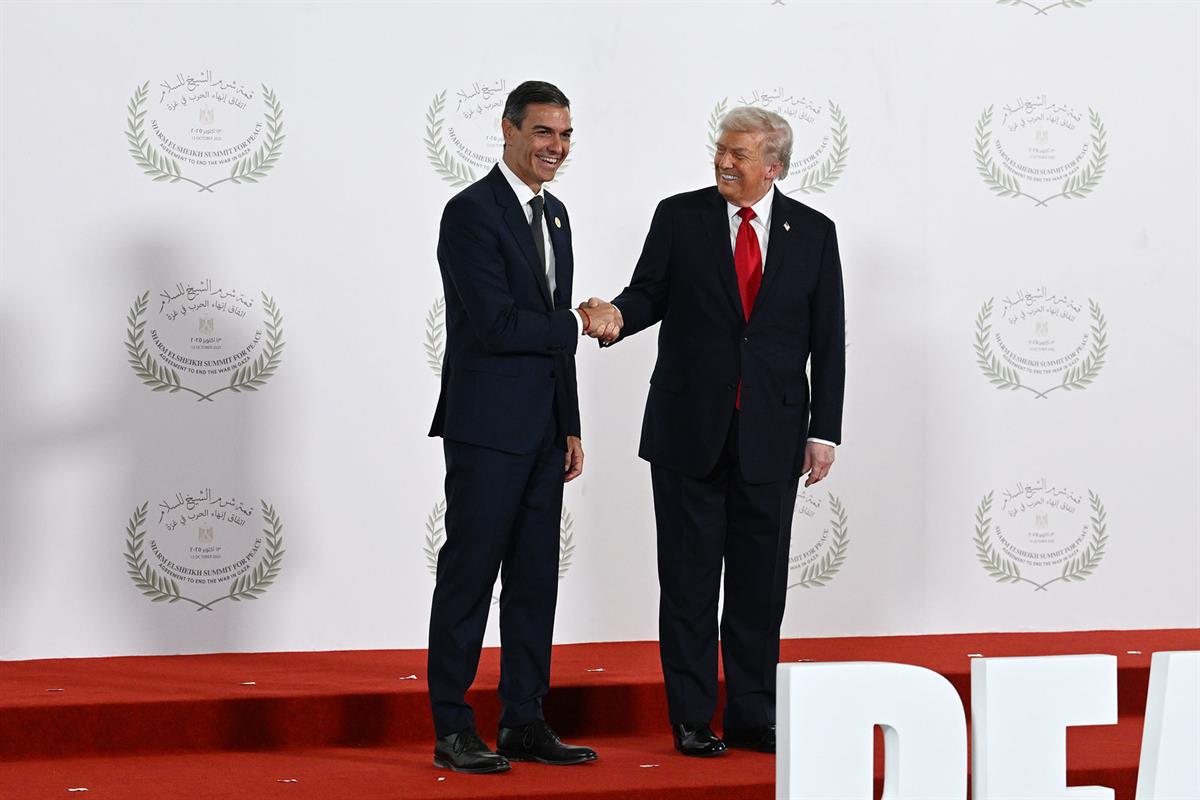
London, England – Spanish Prime Minister Pedro Sánchez confirmed the country would decline U.S. President Donald Trump’s Board of Peace plan while speaking at the EU Council headquarters on January 22, as confirmed by Spain’s presidential house.
According to Sánchez, the board is outside the framework of the United Nations and doesn’t include a Palestinian authority, which is crucial for the Palestinian future.
“Spain defends a coherent position based on European values,” said Sánchez.
Since Spain joined NATO in 1982, there has been relatively little political opposition to a foreign policy that often prioritizes international alignment over domestic needs.
This changed under the current center-left government under Sánchez, who prioritizes national interests and the safeguarding of the welfare state.
Domestic reaction to the rejection
Despite the firm rejection of the proposal, public sentiment in Spain remains positive. For the first time since the post-Franco era, a political course once centered on international integration has placed national interests firmly first.
As signaled by Pablo Díaz Gayoso, a political analyst from the Universidad Complutense de Madrid and founder of digital political commentary and analysis site El Rincón del Pato Cojo, a similarly positive response accompanied Spain’s political course from its entry into NATO in 1982 to 2003.
This enthusiasm stemmed from Spain’s desire to deepen its integration with Europe after nearly two centuries of isolation and dictatorship from the nineteenth through the twentieth centuries, Díaz Gayoso told EU Reports.
The opportunity Spain had to return to democracy forced its people to make a massive commitment to such principles.
In the early period, the primary goal of Spanish political parties was to integrate Spain into international organizations – particularly to secure full participation in European politics through the European Economic Community. This was largely achieved in the 1980s, when Spain successfully joined the EU.
However, as the analyst noted, parties sought to reaffirm their alignment with the U.S. as well, as the country joined NATO following a divisive referendum.
This division did not last long, as the population later tipped the balance in favor of NATO.
“A consensus was reached among the population that membership of both Europe and NATO was the path to democracy, development, and modernization for the country,” explained Díaz Gayozo.
The later years of the 2000s and the period since, despite the illegal invasion of Iraq in 2003 and the global financial crisis in 2008, have been characterized by a broadly liberal public attitude in Spain toward open and progressive policies.
Data from the Spanish Sociological Investigations Center (CIS) supports this assessment. According to its findings, a sharp increase in military spending – reportedly a condition set by Trump – lacks public backing, with more than 70% of Spaniards opposed. Instead, the public prioritizes health spending, viewing it as more urgent.
The acute Palestinian issue
Another key point raised by Sánchez was the mismatch of interests embedded in Trump’s plan, particularly regarding Palestinian sovereignty.
According to the latest Barómetro Elcano report by the Elcano Royal Institute, more than 78% of the Spanish population supports the recognition of a Palestinian state.
Trump’s proposed “Board of Peace” suggests full exclusion of Palestinian authority, instead envisioning the creation of a 15-member National Committee for the Administration of Gaza (NCAG) to run the territory under U.S. oversight.
Sánchez’s response to the idea of Palestine being administered under American supervision was unequivocal, reflecting Spain’s broader rejection of the plan:
“The future of Palestine as a whole should be settled by Palestinians,” the head of state said.
According to Díaz Gayoso, a large majority in Spain support the Palestinian cause. Trump’s contempt for humanitarian norms and his alignment with Benjamin Netanyahu cast doubt on the motives behind the “Board of Peace.”
Conversely, Sánchez’s approach to Gaza and Ukraine remains steadfast and in line with international law.
Rejection viewpoints
With the available data suggesting that the Spanish public broadly supports rejecting the plan, the outlook points to a continued focus on national priorities.
Sánchez’s international approach – primarily focused on the country’s internal interests – is working. As explained by Díaz Gayoso, a politician who maintains stable international positions while prioritizing national concerns commands majority public support.
However, by declining on Trump’s initiatives – much like other Western partners – Spain risks facing reprisals, including higher tariffs, as seen with Canada, and even the threat of marginalization within NATO.
These risks were underscored in October 2025, when Trump labeled Spain a “laggard” and a “bad contributor” during a White House meeting with Finland’s president, suggesting that Spain’s membership in the alliance could be reconsidered.
Featured image: The President of the Government of Spain, Pedro Sánchez, and the President of the United States, Donald Trump, greet each other at the signing ceremony of the Middle East Peace Plan.
Author: Pool Moncloa/Borja Puig de la Bellacasa
Source: La Moncloa