
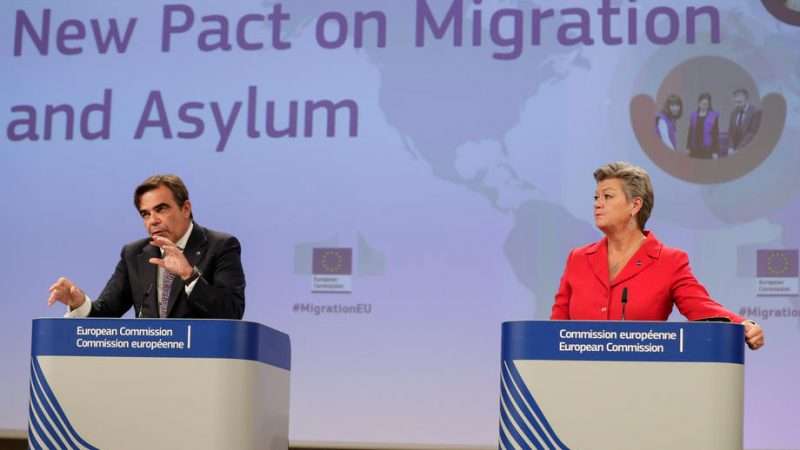

Edinburgh, Scotland – The European Union (EU) Pact on Migration and Asylum, adopted on April 10 2024, marked the most far-reaching overhaul of European asylum rules in the past decade – although it did not formally change asylum law.
By December 2025 – and after a fresh round of migration agreements at the European Council – Marta Welander, EU Advocacy Director at the International Rescue Committee (IRC), said that the EU had entered “the dawn of a dangerous new era” for asylum, suggesting that the procedures would have people “detained for months or years on end, or sent back to countries where they risk facing torture, abuse or worse.”
Brussels, however, has described it as a necessary response to internal divisions over burden-sharing and irregular migration arrivals. Meant to be a pragmatic solution to a system that has become politically unsustainable, the Pact has also left frontline countries like Greece and Italy to absorb disproportionate pressure with little support from northern Europe.
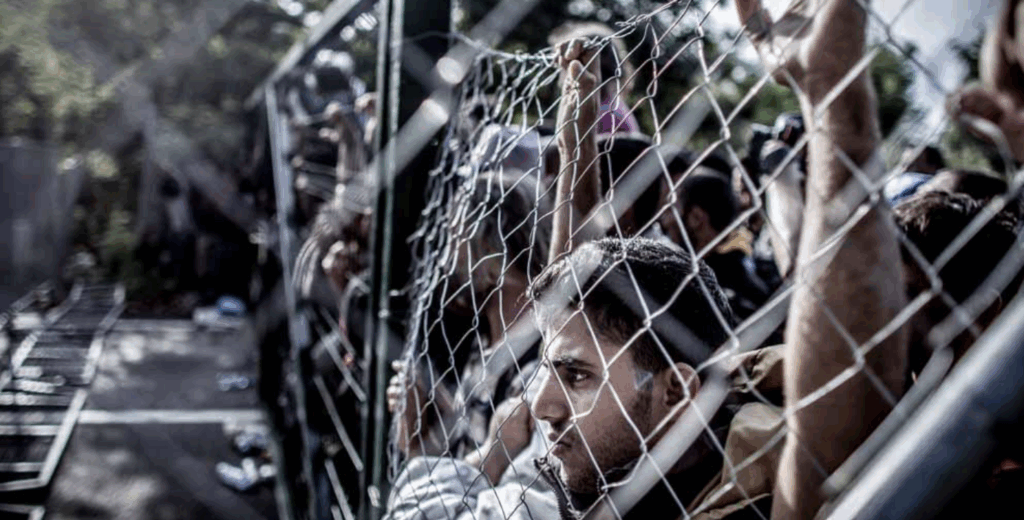
While it has fundamentally transformed who can access it in practice the Pact has also led to humanitarian and legal controversy.
Fast-track procedures and the erosion of due process
Through the Pact, the EU introduced screening of all irregular arrivals at the Union’s borders within seven days – covering security, health, identity, and vulnerability checks. Those considered unlikely to need protection are fast-tracked via an accelerated border procedure, which, if rejected, are sent back without ever being formally admitted to EU territory.
Asylum seekers who transited through designated safe countries risk having their claims refuted without any individual assessment.
The human cost of this new system is not hypothetical. An Afghan refugee, who was pregnant at the time, suffered from Hepatitis B, and the local hospital on Lesvos requested for an urgent transfer back to Athens as far back as February 2023 to access the medical treatment required to prevent irreparable deterioration of her health — and that of her unborn child.
Greek authorities refused her transfer on the grounds that her family’s asylum application had been discarded as inadmissible, and they were sent to Turkey, a “safe third country” instead.
It took an emergency intervention from the European Court of Human Rights on August 1, 2023, to finally push Greek authorities to take action.
Since 2021, more than 10,000 asylum applications have been found inadmissible on the same grounds, with 4,773 inadmissibility decisions issued in 2023 alone and a further 3,222 in 2024, revealing thousands of rejected applicants face the same circumstances.
A new solidarity function, formally known as the Asylum and Migration Management Regulation, replaces the Dublin Regulation, which required asylum seekers to claim protection in the first EU country they entered – a rule that disproportionately burdened Greece, Italy, and Spain.
The new reform gives power to member states to either relocate asylum seekers or pay a financial contribution; an opt-out which could easily be exploited.
When Members of the European Parliament approved the Pact in April 2024, Welander responded with a press statement:
“The Pact will leave troubling cracks deep within Europe’s approach to asylum and migration,” she said, warning that it fails to offer any long-term solutions for those seeking safety within Europe’s borders.
Externalisation: outsourcing obligation
A network of cooperation deals are being simultaneously presented; development partnerships are being signed with Egypt, Tunisia, and Mauritania. However, critics believe that they are migration containment arrangements in disguise.
In Mauritania’s case, for example, the partnership is worth €210 million in exchange for reducing irregular departures.
EU officials have defended the externalisation model, saying it prevents dangerous irregular crossings while also embedding human rights conditionality into partnership agreements – which gives the EU leverage to improve standards in partner countries over time.
However, an August 2025 Human Rights Watch report documented various violations by Mauritanian security forces against migrants, including arbitrary detention, mass expulsions to remote border regions, and torture, carried out around the same time when the western African country was receiving EU migration funding.
Another Reuters investigation from December 2025 also documented migrants left in humanitarian and legal limbo in Mauritania after the deployment of EU-backed enforcement measures, leaving them unable to move forward or return home.
Following the European Parliament’s February 2026 vote approving changes to EU asylum rules, Olivia Sundberg Diez, Amnesty International’s EU Advocate on Migration and Asylum, stated that it was “a very dark day for human rights in the EU.”
Sundberg Diez echoed Welander’s fears, emphasising how asylum applications could now be rejected without any examination of individual merit, with people forcibly transferred to countries to which they have no connection.
The vote approved changes to the ‘safe third country’ concept, while also introducing the first-ever EU-wide ‘safe countries of origin’ list, including nations that have been the subject of European Parliament resolutions condemning the deterioration of their democracy – namely, India, Kosovo, Colombia, Bangladesh, Morocco, and Tunisia.
Spanish Interior Minister Fernando Grande-Marlaska told Reuters that external processing centres, such as Italy’s arrangement to detain migrants in Albania, were “no magic solution” and raised various legal challenges. This is a rare moment of open dissent that reveals the fractures the Pact’s consensus framing has struggled to hide.
The numbers and what they conceal
Official Frontex data shows a reduction in irregular border crossing by 26% across 2025; to almost 178,000, the lowest it has been since 2021.
In November 2025, EU Home Affairs Commissioner Magnus Brunner pointed to the falling figures alongside a reduction in secondary movements and asylum applications as proof of “progress made in implementing the Pact.”
Rights organisations, however, have argued that these numbers do not reflect fewer people fleeing persecution, but rather fewer people successfully reaching EU territory to claim asylum.
Additionally, according to the International Organization for Migration’s “Missing Migrants Project”, over 1,000 people had already died in the central Mediterranean alone by November 2025, with the full annual toll still being compiled. In 2024, about one in every 120 people who attempted the Mediterranean crossing died – a trajectory rights groups say the Pact’s deterrence-first approach has done nothing to reverse.
The IRC also documented a collapse in EU resettlement. In November 2025, member states committed to welcoming only 15,230 people via resettlement across 2026 and 2027, a 75% drop on the earlier two-year commitment.
The credibility question
The EU’s Migration Pact may still prove to be exactly what Brussels believes: a necessary modernisation of a structure that was in need of pragmatic change.
However, the evidence gathered in its first two years of operation suggests a quiet reorganisation of asylum law, accomplished not through formal treaty change, but via the accumulation of procedural restrictions, safe country designations, and externalisation arrangements that together erode the right to protection at its core.
Featured image via EU-Med Human Rights Monitor.