
London, UK – German prosecutors agreed to halt their investigations into EU-sanctioned Russian-Uzbek businessman Alisher Usmanov – accused of violating foreign trade laws – on December 30, 2025.
Prosecutors and the Usmanov defence team said in separate statements that he agreed to pay €10 million ($11.77 million USD) to the German state, as reported by Reuters.
The investigation had declared that Usmanov had not followed his EU sanction regime instructions, including allegations that he spent €1.5 million ($1.745 million USD) on security at two homes in the Bavarian lakeside community of Rottach-Egern in 2022.
Investigators also alleged that he failed to declare jewellery, wine, and art pieces to the German export control office (BAFA). BAFA requires individuals under EU sanctions to declare such items through a special process.
The measures against Usmanov became part of a wider EU sanctions regime, which included EU-wide travel bans and asset freezes targeting Russian oligarchs in 2022.
Introduced in response to Russia’s full-scale invasion of Ukraine, the EU sanctions regime was intended to penalise oligarchs alleged to be involved in or close to Russian President Vladimir Putin’s inner circle.
Usmanov’s business legacy
Usmanov, an Uzbek-origin Russian oligarch, has a net worth currently estimated at $19.2 billion USD, according to Bloomberg’s 2026 Billionaires Index.
The businessman founded Agroplast, a plastic bag company, in the early 1980s and earned millions before the Soviet Union’s collapse, when such products were still a rare commodity.
Shortly after launching Agroplast, Usmanov was convicted by the Soviet government for fraud, corruption and theft of state property, and sentenced to eight years in prison. He served six years – 1980 to 1986 – before his release, after which he resumed building his business empire.
Later, in the early 2000s, Usmanov expanded his holdings by focusing on metals production and acquiring Russia’s largest mobile operator, MegaFon.
His current major asset is USM Holdings, a global conglomerate of metals, mining, telecommunications and tech companies, including Metalloinvest, Udokkan Copper and Akkermann Cement – amassing an approximate $6.4 billion USD.
According to Tradviser Index data, Metalloinvest is Usmanov’s largest revenue-generating business, with total yearly income estimated at $5 billion USD. This makes the company the largest metals producer in Russia, the second-largest pellets producer and the leading producer of merchant HBI in the world.
Following Metalloinvest, Udokkan Copper ranks second, with a production-based revenue estimated at $1.05 billion USD.
Akkermann Cement’s latest available revenue data showed $202 million in 2023. Since then, the company’s revenue has not been publicly reported.
Private holdings status
According to the latest Russian assets tracker, dated 2024, Usmanov’s property includes: at least six Italian villas located on the Sardinian coast; one mansion in Bavaria, Germany; another in England; three Airbuses; three yachts; and one publicly-reported car.
His German properties were raided by authorities in 2022, when investigators alleged Usmanov had used frozen assets after properties were sanctioned, failing to declare valuables, and paid for security services.
At the time, a spokesperson told Reuters: “There can be no reason for suspicion against Mr. Usmanov, who has always duly declared the personal property that was lawfully acquired by him.”
Regardless, German authorities confiscated 30 art pieces worth €5 million – including works by acclaimed Russo-French artist Marc Chagall – stored in his Hamburg property. Alongside the art collection, Fabergé eggs and jewelry valued in millions of euros were also seized.
The mansion also held multiple high-value wine bottles, which failed to be declared.
Known as one of the biggest art patrons in Russia, Usmanov had donated a €20 million art collection to a Russian museum in 2007, including works from renowned Belarusian and Ukrainian painters such as Ilya Repin and Ivan Aivazovsky.
All properties – with the exception of specific art pieces and wines – remain frozen under EU sanctions. The property’s legal status, however, could change with authorities’ recent dropping of investigations.
Credit accounts controversies
In March 2022, the Organized Crime and Corruption Reporting Project (OCCRP) reported on Usmanov’s connection to 27 Credit Suisse accounts. The accounts were indirectly held in the name of his sister, Saodat Narzieva, an Uzbek obstetrician and gynecologist.
As of 2025, the accounts remain unfrozen, despite a partial freeze in early 2022 and Narzieva’s brief inclusion on the EU sanctions list – from which she was later removed.
According to OCCRP, Narzieva was not treated as the true economic beneficiary under EU sanctions law, and investigations suggested the accounts acted as proxies benefiting Usmanov’s business interests.
Regardless, the investigation ended in a negotiated settlement, not formal prosecution, with no charges filed and limits imposed on publishing certain allegations and enforcement actions.
The outcome underscored the complex and evolving nature of sanctions enforcement, shaped by the broader context of Russia’s war in Ukraine and its influence on international business and political dynamics.
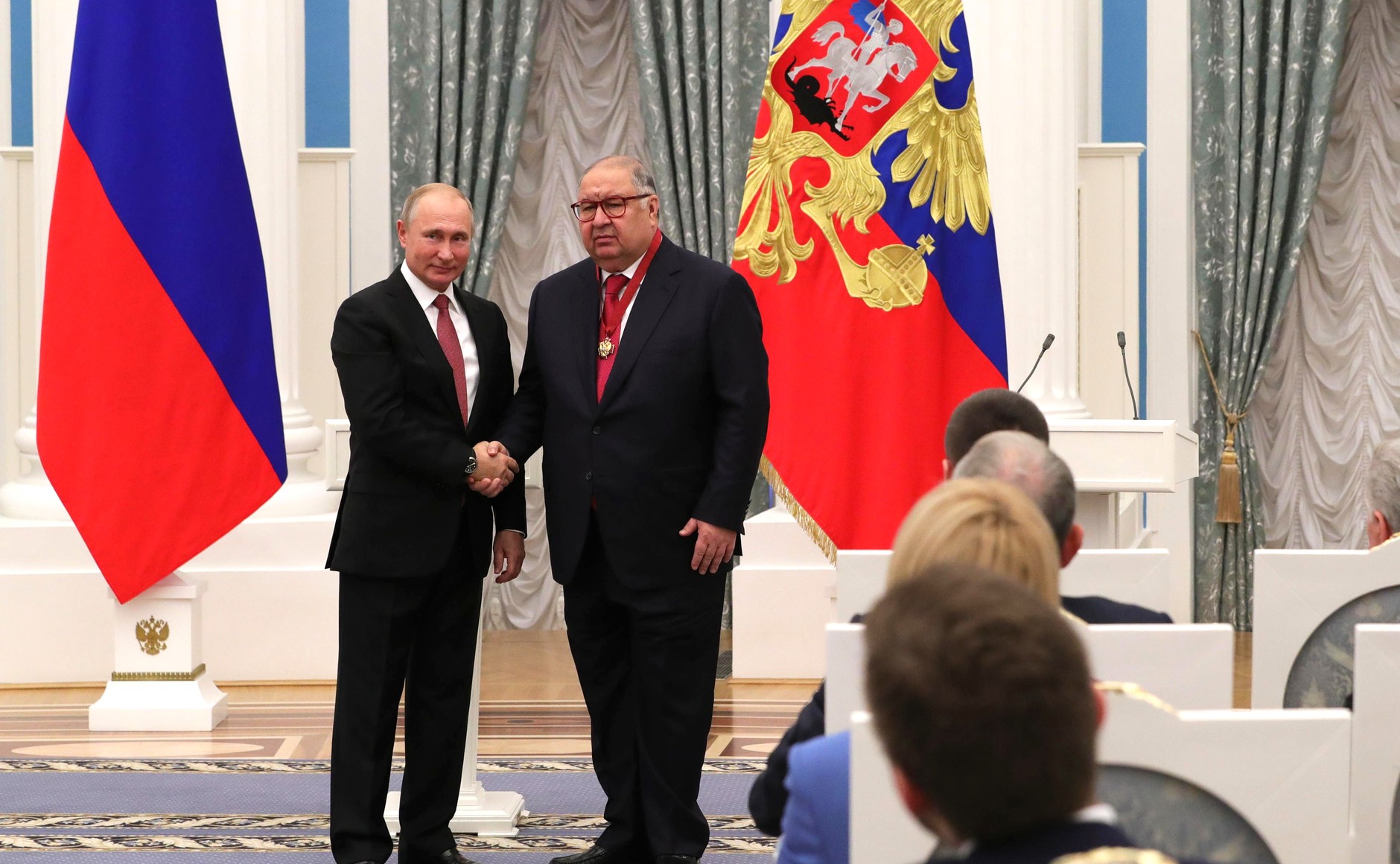
Featured image: Presentation of state awards. The Order “For Merit to the Fatherland,” 3rd class, was awarded to Alisher Usmanov, the main shareholder of USM Holdings.
Source: Russian Presidential Press and Information Office via Wikimedia Commons.
License: Creative Commons Licenses.