
Iceland became the latest European country to boycott next year’s edition of the Eurovision Song Contest on December 10, 2025. Others, including Spain, the Netherlands and Slovenia, have cited Israel’s actions in Gaza as the reason for their boycott.
The European Broadcasting Union (EBU) determined at a December 4 general assembly in Geneva, Switzerland, that Israel would be allowed to participate. In this meeting, members voted to ratify the new rules proposed in November concerning foreign interference in the contest, with no vote on Israel’s exclusion being held.
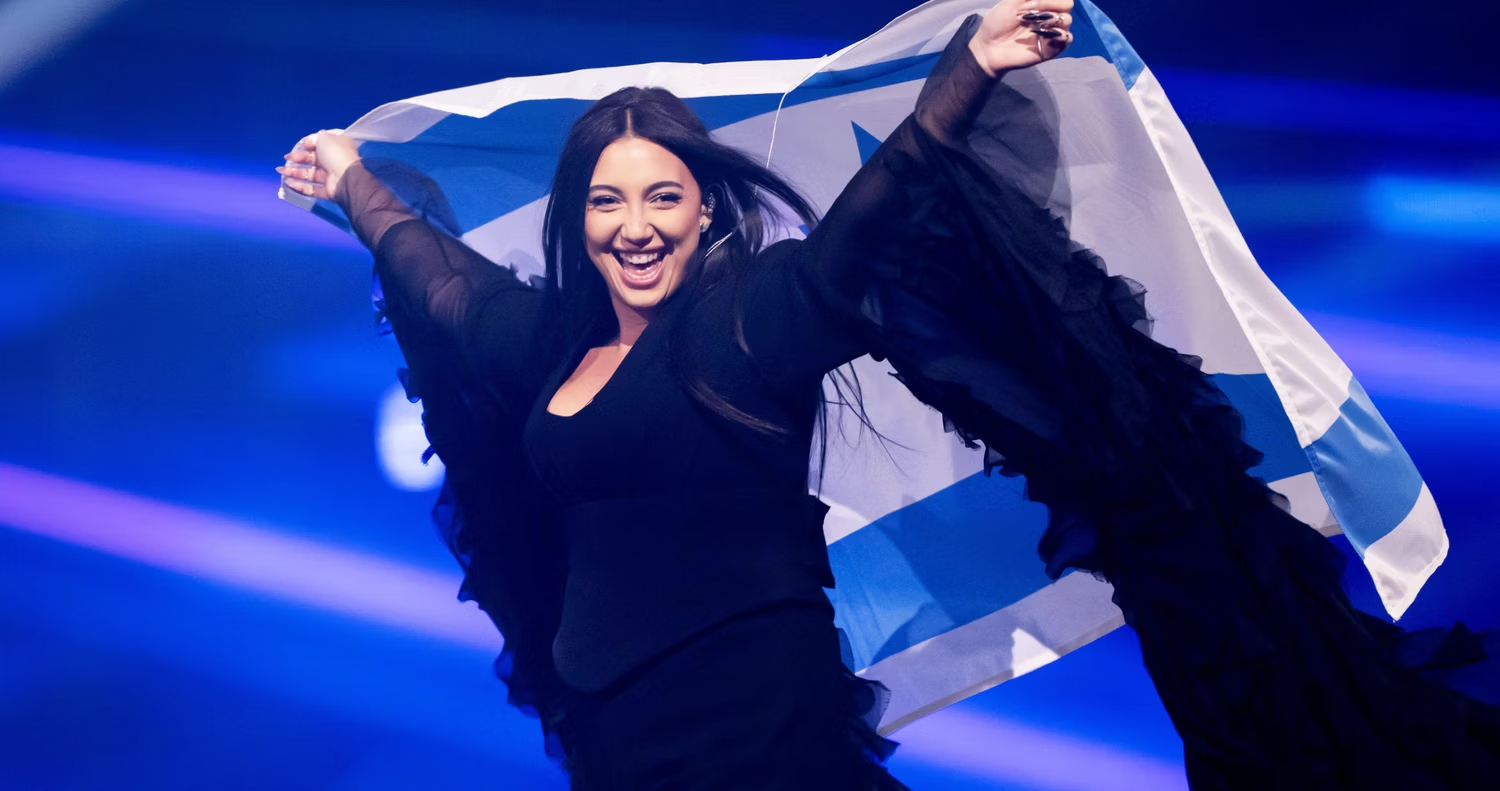
Last month, the EBU announce a change to the voting system in an effort to combat ‘government interference’ in the voting process, an issue that dominated this year’s contest following the second-place finish of Israeli singer Yuval Raphael.
The singer received the highest number of public votes, which Dutch public broadcaster AVROTROS alleged came as a result of “proven interference by the Israeli government.”
As a result of the change, the number of votes that can be made online, via SMS, or phone call has been reduced from 20 to 10.
The meeting in Geneva last week was a vote to gauge member states’ satisfaction with the rule change. If EBU member states did not approve of reforms, a vote on Israel’s participation was to be held.
The Eurovision song contest has been mired in controversy since the start of Israel’s assault on Gaza, which has left 70,000 dead according to the Gaza Health Ministry.
Following the ever-increasing humanitarian toll the war has caused, many fans and broadcasting organisations have expressed their strong reservations to the country’s participation in the contest, with some threatening to withdraw- a commitment that will now be followed.
Spanish broadcaster RTVE, for one, affirmed their official withdrawal from the competition, and that they would not broadcast neither the final nor the semi-finals citing “insufficient measures” to protect the “core principles” of the contest, alongside the “situation in Gaza” and “Israel’s use of the contest for political purposes”.
Echoing this sentiment, Irish broadcaster RTÉ said in a statement that Ireland’s participation “remains unconscionable given the appalling loss of lives in Gaza and the humanitarian crisis there, which continues to put the lives of so many civilians at risk”.
Eurovision has not been a stranger to controversy during its 69-year history. There have been various boycotts over the years, such as Austria’s 1969 boycott over the competition being held in Francoist Spain, and that of Finland, Norway, Portugal, Sweden, and Austria over the marginalisation of smaller countries in 1970.
Dr. Dean Vuletic, author of The Eurovision Song Contest as Cultural Phenomenon and a leading expert in Eurovision history, claimed while in conversation with EU Reports that this latest boycott wave is different.
The incident is “one of the most serious political crises in Eurovision history”, and “certainly… the biggest political boycott of Eurovision ever,” as per Vuletic.
The gravity of the boycott is heightened by the profile of the countries participating: Spain is one of the five countries that contributes the most money to the competition, and Iceland has the most “avid” national base, with over 90% of the national viewing audience watching the contest when it is broadcasted.
Beyond this, the protest is of symbolic importance. All boycotters are “strong, liberal democracies,” which want to show how they view Israel’s participation as an “issue of shared values.”
Alongside this, Dr. Vuletic also pointed to the political victory of the Palestinian BDS (Boycott, Divestment, Sanctions) movement:
“[The boycott represents] the first success from the pro-Palestinian perspective,” he said.
Whilst the ORF, Austria’s national broadcaster, has said that the boycott has been accounted for and will thus not cause severe financial damage to the contest, the loss of viewership from the competition is expected to be 80 million people, according to Vuletic.
He also pointed out the potential revenue loss from a lack of sponsors, questioning whether sponsors would be “as willing to be engaged with Eurovision if it is being seen as somehow politically tainted”.
There are also questions about the future of the Eurovision brand itself. Whilst Dr. Vuletic explained that he does not think that the boycott will threaten the existence of the contest, there has already been significant damage, as “we see this issue really dividing EBU members like no issue ever before.”
Alongside the disruption caused within Europe itself, the boycott also threatens to impact global Eurovision strategy, especially with regards to Latin America, due to Spain’s withdrawal.
Spain, alongside their status as a significant market for the contest, is also “a bridge between Eurovision and Latin America”.
Indeed, the contest has enjoyed high viewership in the region, and there are plans to expand the contest through a Latin America edition.
Next year’s contest thus promises to be one of the most controversial in the competition’s history, as it reaches its 70th anniversary: a reflection of the significant global division caused by the devastating conflict in Gaza.
Featured image: Yuval Raphael
Source: Heute.at
License: Creative Commons Licenses